 QuickPLS
Empirical study / Academy of Management Journal
Building Better Causal Theories: A Fuzzy Set Approach to Typologies in Organization Research
Authors and publication: Fiss, P. C. (2011). Academy of Management Journal, 54(2), 393–420.
Read the original paper DOI: 10.5465/AMJ.2011.60263120. The supplied practice data are a separate teaching example.Some organisations succeed through one combination of strengths; others succeed through another. Fiss uses fuzzy sets to study this kind of question. In this exercise, capacity, coordination and reach describe a small delivery study. You will follow each answer back to the cases behind it. These invented cases are separate from the firms and findings in the paper.
View the method overview

Open the data and give the sets a meaning
Download delivery-memberships.csv and read its data notes. The ten practice cases have values for capacity, coordination, reach and success. A membership says how strongly a case belongs to a set: 1 means fully in and 0 means fully out. The values in this file are already memberships. Keep case_id as a label, and write what each set means before calculating.
Save the study and its first setup
Choose File → New Project… (Ctrl+N). Enter Delivery practice in Project name. Use Browse… beside Project file to choose a save location, then click Create project. Choose File → Import Data… (Ctrl+I), click Choose data file… and select delivery-memberships.csv. In Review & import, check Header row 1, comma separator and Decimal convention Dot (1.25), then click Import dataset. Confirm ten cases.
Select the imported dataset, choose Calculate… and find Fuzzy-set Qualitative Comparative Analysis. Open Method settings. Under Study and named specification, enter Delivery practice in Study name and Baseline in Specification name. A specification saves your analysis choices.
Under Conditions, use Add condition to select capacity, coordination and reach. Under Outcome and case identity, select success as Outcome variable, Presence of the outcome as Analyse and case_id as Case identifiers. Choose Save study draft. If QuickPLS asks you to save a working copy of a protected project, save it and continue in that copy; otherwise, continue in your current project.
Inspect the two cases needing a decision
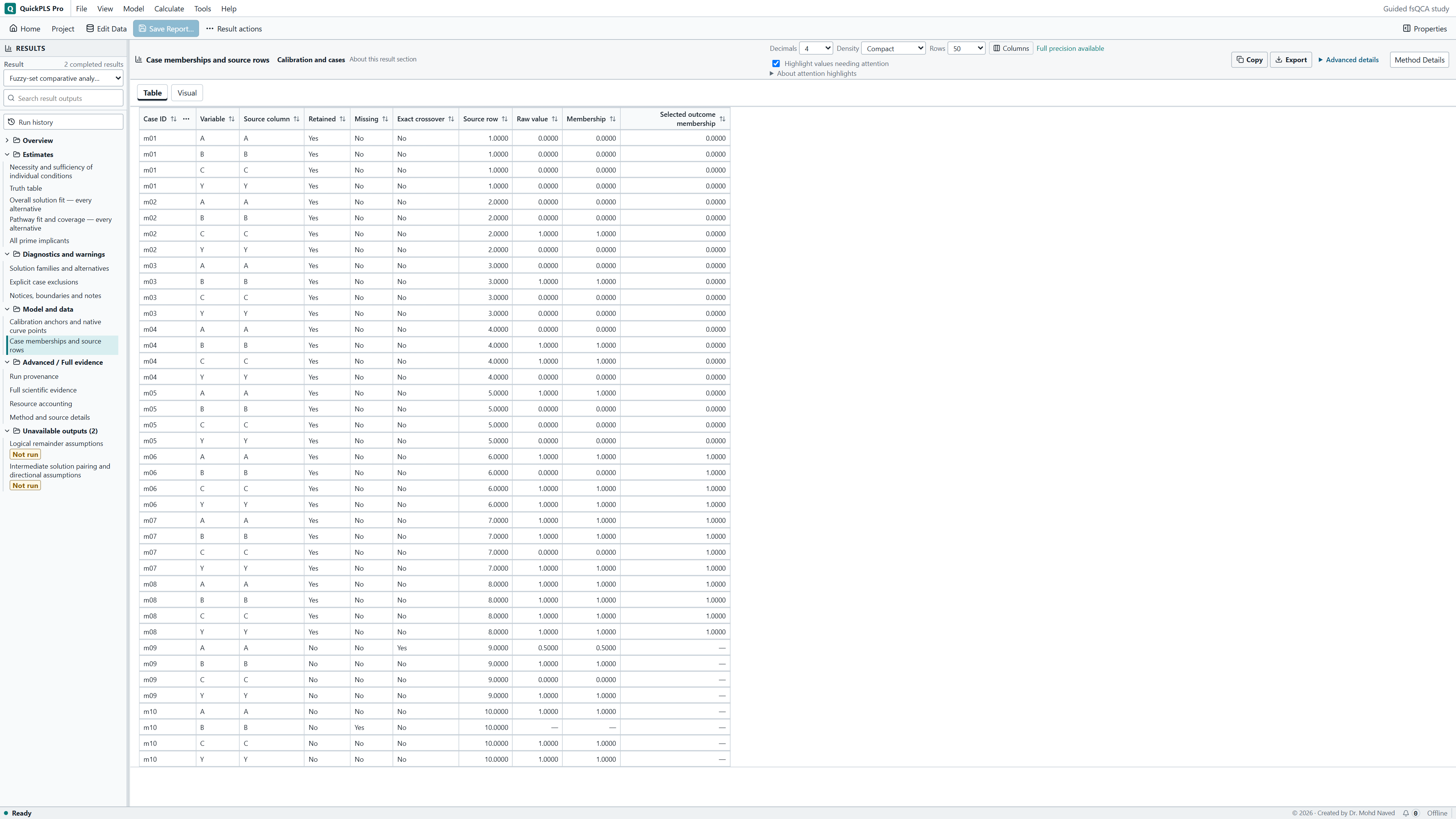
With Guided selected, open Calibrate and choose Existing membership [0, 1] / crisp 0 or 1 for every condition and the outcome. Then open Inspect cases. Case d09 has capacity = 0.5, where it is neither more in nor more out of the set. Case d10 is missing coordination.
Expand Data: missing values and exact crossovers. Set Missing selected values to Exclude affected cases and record every exclusion; this handles d10. For d09, enter 9 in Source row to exclude, enter capacity is exactly 0.5 in Exclusion reason and click Record deliberate crossover exclusion. Row 9 means the ninth data row, without counting the header. Record the reasons in the study's Decision notes and check that d01 to d08 remain. These exclusions are choices for this exercise; justify a case rule before looking for a preferred solution in research data.
Read the truth table before simplifying it
In Analysis choices, set frequency 1, consistency 0.80 and PRI 0.50. Frequency is the minimum number of cases supporting a combination. Consistency describes how closely that combination fits within the outcome. PRI helps reveal a combination that overlaps with both the outcome and its absence. These settings belong to this exercise. Leave Request intermediate solutions with explicit directional expectations unchecked for this baseline.
Select Inspect truth table and open the cases behind each row. Confirm the eight included cases and outcome presence. After any change to settings or cases, choose Refresh truth-table preview. Return to Study and named specification and choose Save study draft again so Baseline records the final case decisions and thresholds. Wait for the Study draft saved confirmation before starting the calculation.
Follow one complete solution to its cases
Choose Start calculation. In Results, select the completed delivery calculation and confirm eight included cases. Open Investigate solutions, set Solution family to Conservative and choose Inspect for its complete alternative. Read capacity AND coordination, OR capacity AND reach as two possible pathways in one solution. Use Pathway to inspect to follow each one, then Whole solution only to view their combined coverage. A condition omitted from a pathway is unrestricted there; it is not necessarily absent or unimportant. For the comparison in the answer check, select the Parsimonious family separately and inspect its complete alternative.
This screen shows case inspection in the separate Guided fsQCA practice project. Use delivery-memberships.csv for the exercise above.
Report the baseline and one planned change
Save the explanation of your case choices and thresholds with the study. In the report builder, select the completed result, its solution and the saved revision under Report-time study notes. Prepare and save the report, then export and reopen it. To try a different threshold, save a new named specification first. Compare its cases and solution with the baseline, and explain the reason for the change.
Settings and answer check
Check the expected combinations
This small example has a result you can check case by case. The answer below was confirmed with QCA 3.25 and a separate calculation of the possible combinations.
Use this setup first
- Choose capacity, coordination and reach as conditions, and success as the outcome. Use existing memberships.
- Exclude d09, which is at the crossover, and d10, which has a missing value. Record both decisions. Eight complete cases remain.
- Use frequency 1, consistency 0.80 and PRI 0.50. Analyse outcome presence. Compare the conservative and parsimonious solutions.
| Result | Reference answer |
|---|---|
| Solution | capacity AND coordination, OR capacity AND reach |
| Solution consistency | 1 |
| Solution coverage | 1 |
| Solution PRI | 1 |
| Capacity alone: sufficiency consistency | 0.75 |
| Capacity alone: necessity consistency | 1 |
What this tells you
The successful cases are d06, d07 and d08. All require capacity, but capacity by itself does not guarantee success. Every binary combination is observed, so the conservative and parsimonious solutions coincide in this exercise.
If your answer is different
If your solution differs, check the eight included cases, outcome presence and all three thresholds. A solution term can list its conditions in another order and still mean the same thing.
The QCA result agreed with a separate calculation of memberships and Boolean combinations in all 86 checks of numbers and solution structure.
Reference answers; this example has not been rerun in QuickPLS.
How these answers were checked
These are independently checked reference answers. This fsQCA practice dataset has not been rerun in QuickPLS for this pack. The app screenshot is from a separate saved practice project.
The download includes the exact practice CSVs, unrounded results, model settings and scripts to repeat the reference calculation. It does not contain data from the cited papers or the QuickPLS application.
The point of the exercise
Read the result in context.
The reference answer is capacity AND (coordination OR reach). Cases d06, d07 and d08 are successful, and d08 belongs to both pathways. Read the checked-answer table above, then verify the pattern in the CSV. Capacity alone also includes an unsuccessful case, which explains why being necessary differs from being sufficient. Every binary combination is observed here, so the exercise does not need assumptions about unobserved combinations. Those assumptions and core/peripheral labels require a separate example.
Avoid this mistake
Do not add overlapping pathway coverage to obtain whole-solution coverage. Do not treat membership as a probability or an omitted condition as a small regression effect. If you want to explain unsuccessful delivery, calculate outcome absence separately. In a research study, also examine how defensible changes to calibration and thresholds affect the conclusion.
Your practice material
Ten invented cases, including one exact crossover value and one missing value. The baseline exercise uses the other eight cases. These original teaching data are available under CC0; they are not observations from the cited paper.
About this exercise
The instructions were checked against the documented app controls. The answer table uses QCA and independently calculated reference answers. This delivery file has not been rerun from start to finish in the installed QuickPLS app.