 QuickPLS
What the method does
Logical minimisation simplifies qualifying configurations into pathways. A solution may contain several pathways and the analysis may produce more than one complete alternative. Pathway consistency, raw coverage, unique coverage and solution coverage describe different aspects of fit. Keep each complete alternative intact when interpreting its cases.
For solution S = P₁ OR P₂, Sᵢ = max(P₁ᵢ, P₂ᵢ).
P₁ᵢ and P₂ᵢ are case i’s memberships in the two pathways. The union uses the maximum, so overlapping pathway coverages cannot simply be added. Unique coverage concerns a pathway’s non-overlapping contribution.
Data and analysis in QuickPLS
Start with a completed fsQCA result whose calibration, case decisions and truth-table thresholds are known.
QuickPLS displays solution families, alternatives, pathway fit and case memberships. Match family and solution identifiers before linking a pathway to its cases.
Follow a worked example
The following example shows the data, settings and decisions for one analysis. Use the linked practice files to follow it. For your own study, keep the procedure and choose the variables, model and settings that fit your research question.
Download memberships.csv to begin. It contains 10 rows and 5 columns. The example below identifies the variables to use, their roles and any rows to exclude; not every column is an analysis variable.
Start with one complete solution
A pathway joins conditions with AND. A complete solution can join several pathways with OR. The analysis may return more than one complete solution, called alternatives. Each alternative is a separate answer under the selected rules. Taking attractive pathways from different alternatives creates a new expression that the selected result did not calculate.
Choose one alternative, then read its conditions. Presence means membership in a set; absence means membership in its opposite, or complement. Omission means that a pathway does not require either presence or absence of that condition. An omitted condition has not failed a significance test. It may feature in another pathway or alternative.

Use a completed result linked to its original cases
Open a completed fsQCA result and keep the original dataset available. Use its solution and pathway tables alongside Case memberships and source rows. A printed formula alone cannot show which cases support or challenge the explanation.
Follow a solution from its formula to the cases
Select the completed result
In Results, use Result to select the intended fsQCA calculation. Confirm its dataset, outcome and settings.
Identify one complete alternative
Open Overall solution fit — every alternative. Choose the family and Solution identifier you will report. Then find the matching rows in Pathway fit and coverage — every alternative; read all pathways belonging to that same alternative.
Connect the pathways to cases
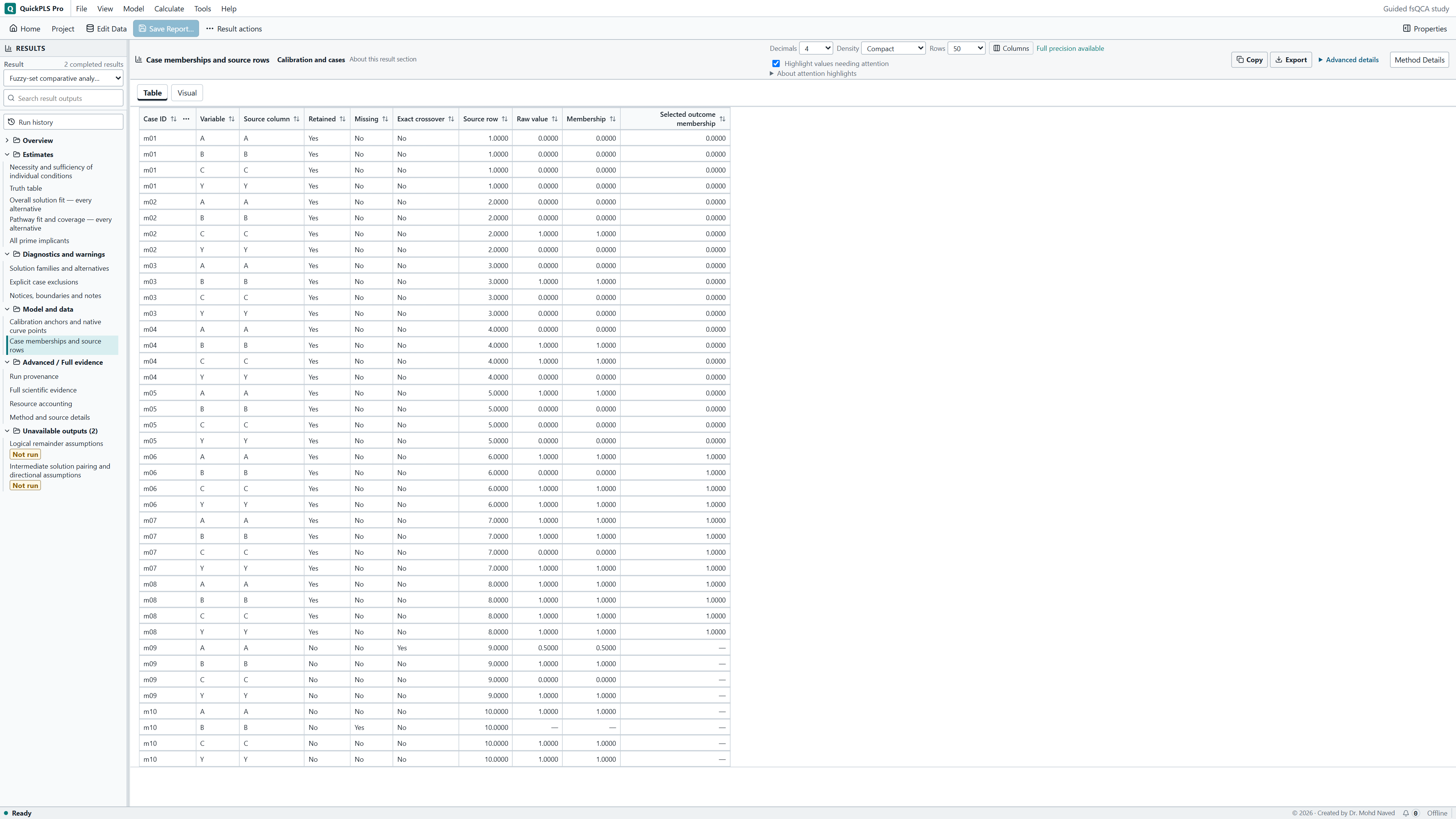
Open Case memberships and source rows. For the chosen expression, use each case’s condition memberships to calculate AND as the smallest membership and OR as the largest. Compare that pathway or whole-solution membership with the outcome. The worked example below shows this operation.
Use a supported pair for advanced labels
If you need core/peripheral notation, open Investigate solutions and choose a compatible intermediate/parsimonious pair. Keep that exact pair with the report. The ordinary pathway and solution tables are sufficient for the overlap exercise below.
Ask what fits, what is covered and which cases overlap
Consistency asks how closely a pathway sits within the outcome set. Coverage asks how much of the outcome it covers. A consistent pathway may apply to only a small part of the outcome, while broad coverage may come with important exceptions. Raw coverage includes the pathway's overlap with other pathways. Unique coverage is its additional contribution beyond the others in this selected solution.
Core and peripheral labels come from a particular intermediate and parsimonious solution pair. They do not measure effect size or rank conditions by general importance. Identify the pair and its assumptions so readers can connect those labels with the actual expression, fit and cases.
Use the case view to make the interpretation concrete. A condition omitted from a pathway is unrestricted there. Check whether cases with different memberships in that condition are covered, and keep each complete alternative separate as you read its consistency and coverage.
For the delivery example, locate m06, m07 and m08 in Case memberships and source rows. The hand table below calculates their memberships in A*B, A*C and the combined solution. These binary values explain the overlap directly; a fractional raw-score screenshot would describe a different exercise.
On a small screen, swipe the table sideways to see every column.
| Output | How to read it | What to check |
|---|---|---|
| Solution family and alternative | Select one conservative, parsimonious or intermediate alternative before reading its formula and fit. | Each alternative covers the selected configurations in its own way. Joining alternatives creates a formula the analysis did not calculate. |
| Consistency and coverage | Read whether a pathway is a subset of the outcome and how much outcome membership it covers. | Coverage is not variance explained, and consistency is not a statistical probability. |
| Raw and unique coverage | Separate a pathway’s total coverage from the coverage it adds beyond the other pathways in the selected solution. | Unique coverage depends on the other pathways in the selected solution. |
| Supporting and deviant cases | Use original case membership to understand both support and exceptions for the selected formula. | One illustrative case is not evidence that every case follows the proposed explanation. |
Use three successful cases to understand two pathways
For this exercise, A means high capacity, B broad reach, C strong coordination and Y successful delivery. These are invented meanings for supplied memberships. Include m01 to m08 and explicitly exclude crossover case m09 and incomplete case m10. We will ask which successful cases each pathway covers and where they overlap.
Open the saved membership result in fsqca_guided_study.qpls, or calculate memberships.csv using the baseline in the introductory fsQCA guide. Check that the result uses eight included m-cases rather than the separate raw-score example. The numbers below can be counted directly from the CSV and match the supplied saved result; they do not describe a new app run.
A logical remainder is a condition combination without enough observed case support under the selected rule. A solution family tells you which simplification assumptions were used. A conservative solution does not use remainders for simplification. A parsimonious solution allows them. An intermediate solution uses directional expectations, meaning your stated expectations about whether a condition's presence or absence helps the outcome, to limit the simplifying assumptions. Read those choices before comparing the returned alternatives.
Read AND, OR and absence in the formula
A*B + A*C means capacity AND reach, OR capacity AND coordination. The asterisk joins conditions within a pathway; the plus sign joins the pathways. For fuzzy memberships, AND takes the smallest component membership and OR takes the largest. In these binary cases, a case must meet both conditions of a pathway, but either pathway can place it in the combined solution.
Presence uses the condition membership. Absence uses its complement, calculated as one minus that membership. Omission leaves the condition unrestricted. Thus, leaving C out of A*B does not say that C is absent, statistically insignificant or irrelevant everywhere. It says this pathway does not require a particular C membership.
Inspect the pathway cases and their overlap
Check the membership baseline
Select the existing-membership result, not the raw-score logistic result. Confirm eight included cases, frequency 1, consistency 0.80 and PRI 0.50.
What you should see: The intended membership baseline and case decisions are selected.
How to read it: Confirm the outcome direction.
Read one complete alternative
Open Overall solution fit — every alternative and note the conservative Family and Solution identifier. Read its matching pathways in Pathway fit and coverage — every alternative. Keep A*B + A*C together.
What you should see: One complete solution alternative is identified by family and solution.
How to read it: Do not combine pathways from incompatible alternatives.
Check capacity and reach
In Case memberships and source rows locate m07 and m08. Both have A = 1 and B = 1, so both belong to A*B. Their C values differ, showing why this term leaves C unrestricted.
What you should see: The capacity-and-reach pathway is linked to its supporting cases.
How to read it: Check consistency and coverage for that exact pathway.
Check capacity and coordination
Locate m06 and m08. Both belong to A*C. Case m08 belongs to both pathways, so the two pairs do not represent four separate successful cases.
What you should see: The capacity-and-coordination pathway has its own case memberships.
How to read it: Identify cases shared with the other pathway.
Read whole-solution fit
Return to the matching row in Overall solution fit — every alternative. Compare its consistency and coverage with the pathway measures. Use the table below to check the OR operation that counts m08 once.
What you should see: Whole-solution fit describes the union of pathways.
How to read it: Shared cases explain why raw pathway coverage cannot be added.
Count coverage without counting the shared case twice
There are three units of Y membership because m06, m07 and m08 each have Y = 1. A*B covers two, so its raw coverage is 2/3. A*C also covers two. Each pathway covers one successful case that the other misses, so each has unique coverage 1/3. The overlap is m08, another 1/3 of outcome membership.
The union, meaning the combined OR expression, covers all three successes and none of the unsuccessful included cases. Its consistency and coverage are therefore both 1. Adding raw coverages gives 4/3 because m08 is counted twice. Adding unique coverages gives 2/3 because their shared contribution is left out. Use the union's coverage for the whole solution. These hand counts agree with the supplied saved membership output.
On a small screen, swipe the table sideways to see every column.
| Case | A*B | A*C | Combined solution | Y |
|---|---|---|---|---|
| m06 | 0 | 1 | 1 | 1 |
| m07 | 1 | 0 | 1 | 1 |
| m08 | 1 | 1 | 1 | 1 |
Use m05 to see why capacity alone is not enough
A appears in both pathways, but A alone also includes m05, where A = 1 and Y = 0. Of the cases with capacity, only three of four are successful. Capacity alone therefore has sufficiency consistency 3/4, compared with 1 for the selected full expression. The extra case explains why the combination with reach or coordination matters here.
Case m07 shows the capacity-and-reach route without coordination; m06 shows the capacity-and-coordination route without reach. These are alternative combinations in this dataset. They do not show a universally positive or negative effect of reach or coordination. A pathway describes a set relationship, not a regression coefficient.
Necessary and sufficient also ask different questions. A necessary condition is present whenever the outcome is present. A sufficient pathway fits within the outcome. Capacity appears in every successful case here, but m05 shows why that alone does not make capacity sufficient. Keep this observation about the teaching cases separate from a claim about all organisations.
Keep alternative explanations separate
An analysis may return several minimal complete expressions under the same rules. Each is an alternative, and its pathways belong together. If you join a preferred pathway from one with a preferred pathway from another, you have made a different expression. Its fit and interpretation would need their own calculation and justification.
Where supported, core/peripheral notation compares an intermediate solution with a compatible parsimonious alternative. The labels are not derived by ranking raw coverage. This delivery exercise can teach overlap and case coverage without adding those labels. If the selected method does not supply the required pair, report its expression, memberships and fit directly.
For a supported core/peripheral comparison, QuickPLS matches an intermediate pathway to one compatible parsimonious pathway that is at least as broad. A shared condition state is core; an extra intermediate condition state is peripheral. If no compatible match or more than one match exists, the labels are unavailable. These labels describe the chosen pair, not causal-effect strength.
Check the selected expression before judging its fit
Most reading errors here come from mixing alternatives, adding overlapping coverage or treating omission as absence. Return to the selected complete expression and its original cases before changing the analysis.
On a small screen, swipe the table sideways to see every column.
| What seems wrong | What to inspect | What to do |
|---|---|---|
| Coverage appears to exceed 100% | Whether you added raw coverages of overlapping pathways | Use the union’s solution coverage and identify the shared cases. |
| An omitted condition is described as absent | The condition pattern and the definitions of presence, absence and omission | Read omission as no constraint in that pathway, then inspect its cases. |
| A pathway list changes unexpectedly | The selected family and complete alternative | Select and report one actual alternative consistently. |
| Capacity alone is claimed sufficient | Case m05 and the broader A set | Report the 3/4 consistency of A alone separately from the complete solution. |
| A core label has no supporting comparison | Whether an eligible intermediate/parsimonious pair was selected | Use only labels supported by that pair, or omit the label. |
Report the expression and what each pathway adds
Name the solution family and complete alternative in your report. Describe the cases unique to each pathway and the shared cases. The table below gives pathway coverage separately from whole-solution fit; unique coverage is a pathway contribution, not a whole-solution measure.
On a small screen, swipe the table sideways to see every column.
| Expression | Consistency | Raw coverage | Unique coverage |
|---|---|---|---|
| A* | 1 | 2/3 | 1/3 |
| A* | 1 | 2/3 | 1/3 |
| A* | 1 | 1 | Not a pathway-level value |
Example Methods paragraph
We inspected each pathway of the selected solution against the original included cases. Raw coverage described the outcome membership covered by a pathway, while unique coverage identified its contribution beyond the other pathway. Shared cases were counted once in the combined solution.
Turn the symbols into a clear explanation
You could write: Capacity with reach covered m07 and m08; capacity with coordination covered m06 and m08. Each pathway covered two-thirds of the successful cases, with one-third uniquely covered. Together they covered all three successes. Case m08 accounts for the overlap. Capacity alone also covered unsuccessful m05, so it did not have perfect sufficiency consistency.
Before exporting, check that the report selects the alternative whose cases you inspected. If you choose another alternative, inspect its cases as well. Similar-looking formulas can distribute shared and unique contributions differently; the selected cases and memberships make that difference visible.
- Explain why the union counts m08 once.
- Find the case covered only by each pathway.
- Use m05 to distinguish necessity from sufficiency.
- Record the actual solution family and complete alternative.
- Keep the case labels so another reader can repeat your inspection.
Report the solution you actually inspected
Keep the pathways of one complete alternative together. If you use core/peripheral notation, explain the selected pair that produced it. Neither an omitted condition nor a peripheral label is a small regression coefficient.
Open the membership exercise
Use a copy of the saved fsQCA project or its memberships CSV to practise reading complete alternatives and case memberships. These are supplied teaching results, not a calculation you have just run or a replication of journal data. Preserve the original project for comparison.