 QuickPLS
What the method does
Logical remainders are configurations without observed cases. Using them in minimisation introduces assumptions about what would happen in those configurations. Conservative, parsimonious and intermediate solution families differ in their use of such assumptions. Directional expectations should come from substantive reasoning rather than the desired final formula.
Boolean simplification: A·B + A·~B = A.
If one term is an unobserved configuration, this simplification depends on treating that remainder as compatible with the outcome. The algebra is valid, but the empirical conclusion also requires the counterfactual assumption to be justified.
Data and analysis in QuickPLS
Use a calibrated study with a known truth table and explicit directional expectations where intermediate solutions are requested.
QuickPLS records the relevant remainder and directional assumptions with the solution. Read those records alongside the observed configurations and supporting cases.
Follow a worked example
The following example shows the data, settings and decisions for one analysis. Use the linked practice files to follow it. For your own study, keep the procedure and choose the variables, model and settings that fit your research question.
Download counterfactual.csv to begin. It contains 2 rows and 4 columns. The example below identifies the variables to use, their roles and any rows to exclude; not every column is an analysis variable.
A combination missing from the sample may still be possible
Suppose your sample contains organisations with both capacity and access, and organisations with neither. It tells you little about organisations with only one of those conditions. Such unobserved combinations are called logical remainders. Using assumptions about them can shorten an fsQCA explanation. Calling a combination impossible is a stronger claim: it needs knowledge of the study setting, not just an empty row in the sample.
Inspect what is known about the conditions before making that claim. If a case has known conditions but a missing outcome, its condition combination still occurred. The conflict file in this lesson shows why leaving a case out of outcome calculations does not erase that observation.
Save the study and write down the assumptions you can defend
Save the research question, set definitions and source data. Prepare actual calculations for outcome presence and absence, meaning the outcome and its complement. For each combination you propose to exclude or declare impossible, write down the reason and which outcome direction the decision concerns.
Inspect and save the counterfactual choices
Load the intended study
From a completed result, open Counterfactual reasoning. Choose the Owning study and Saved specification revision, then Load selected setup. Review the copied choices; loading does not calculate anything.
Record any justified restrictions
Open Impossible configurations, Presence remainder exclusions or Absence remainder exclusions as appropriate. Add the complete Binary pattern in the displayed condition order and its Rationale. Keep these decisions distinct.
Choose how to state expectations
For each outcome direction, choose Separate atomic directions or One jointly interpreted conjunction under Expectation form. State which conditions are expected present or absent and explain why. You can also leave No intermediate solution requested selected.
Inspect both outcome directions
Use Inspect both truth tables. Save counterfactual revision with a clear name, then Calculate both outcomes from that exact saved revision.
Read each returned alternative with its assumptions
Inspect conservative, standard parsimonious, enhanced parsimonious and intermediate alternatives separately. Check the remainders and conflicts behind the selected complete expression. Keep its family, pair and alternative identified in the report.
Read the assumptions as part of the explanation
An atomic expectation concerns one condition on its own. A conjunction is a joint expectation, such as capacity present AND access present. The joint statement does not become two independent expectations. Save its reason and the outcome direction it concerns.
The conservative solution uses the observed evidence without remainder-based simplification. Standard parsimonious alternatives can use permitted remainders to simplify it. Enhanced parsimonious alternatives reflect the extra restrictions and conflict procedure you selected. An intermediate alternative uses the stated expectations and belongs to an exact conservative/enhanced-parsimonious pair. Keep these outputs separate.
For the expression you report, identify which unobserved combinations were used and why those assumptions are credible in your study. A shorter formula is easier to write, but its length does not establish that its assumptions are better supported.
Under Cross-outcome simplifying assumptions, Exclude the recorded conflict union once removes the collected conflicting assumptions in one pass. Inspect any remaining conflicts afterwards. The procedure does not repeat until every conflict disappears. Keep the actual conservative/enhanced-parsimonious pair with each intermediate solution.
On a small screen, swipe the table sideways to see every column.
| Output | How to read it | What to check |
|---|---|---|
| Impossible and excluded remainders | Read why each combination was excluded and whether the decision applies to outcome presence or absence. | A configuration observed with a missing outcome is still observed and cannot be declared impossible. |
| Unobserved combinations used by a solution | Follow how the selected solution uses each logical remainder. | A shorter formula still needs a convincing explanation of its assumptions. |
| Intermediate pairing | Keep the exact conservative/enhanced-parsimonious pair used for the intermediate alternative. | An unrelated pair cannot support the intermediate solution or its core/peripheral labels. |
| Expectations | Distinguish expectations about individual conditions from the supported joint expectation for each outcome direction. | A joint expectation keeps the conditions together. Unsupported mixtures cannot be calculated. |
Compare the ordinary and conflicting teaching files
Use the two CSVs below or a copy of Research choices and calibration. The saved teaching results let you compare the assumptions and their effects on each solution. Keep the original files while trying a separately named assumption.
Start with two observed combinations and two gaps
Open counterfactual.csv. Case f01 has A = 0, B = 0, Y = 0; f02 has A = 1, B = 1, Y = 1. For teaching, call A adequate capacity, B suitable access and Y successful delivery. These are invented meanings. The purpose is to understand assumptions, not to establish an explanation of real services.
Two binary conditions create four configurations. Only 00 and 11 occur, so 01 and 10 are unobserved. Without using those gaps for simplification, the conservative presence expression is A*B and the conservative absence expression is ~A*~B. The asterisk means AND; the tilde means absence of that condition.
Separate three different research decisions
An impossible configuration is a combination you claim cannot occur in this setting. An excluded remainder is an unobserved combination you choose not to use for simplifying a particular outcome analysis. A directional expectation says how a condition, or a supported combination of conditions, is expected to relate to the outcome. Each decision needs its own reason.
Choose Paired counterfactual reasoning: declared positive expectations in the saved project. The baseline uses frequency 1, consistency 0.80 and PRI 0.50, with no contradiction band or case exclusions. Both observed cases remain in the analysis while you inspect 01 and 10. Perfect fit to two observations does not establish what would happen in either unobserved combination. Frequency sets minimum case support; consistency measures agreement with the selected outcome. PRI helps identify combinations that also fit its absence. The optional contradiction band marks a declared range of borderline rows as contradictory; this baseline leaves it off.
As a separate exercise, exclude remainder 10 for one explicitly chosen outcome direction. Check that it is a remainder on that side and explain why you do not want to use it. You are restricting a simplifying assumption. You are not deleting an observed case or claiming that 10 is impossible in the setting.
Follow the assumptions on both sides of the outcome
Load the saved counterfactual setup
Open the saved counterfactual result from fsqca_research_choices.qpls and choose Counterfactual reasoning. Select the study for counterfactual.csv and Paired counterfactual reasoning: declared positive expectations as the saved revision, then Load selected setup. Confirm A, B and Y, with patterns read in A, B order.
What you should see: The saved counterfactual example is selected.
How to read it: Confirm its cases, conditions and outcome before adding expectations.
Read the baseline decisions
Inspect Impossible configurations and the separate Presence remainder exclusions and Absence remainder exclusions. Read the expectations before adding a new decision.
What you should see: The baseline distinguishes observed rows from remainders.
How to read it: An unobserved row is not evidence of outcome absence.
Build a supported expectation
Use Expectation form for each side. Separate atomic directions concerns individual conditions. One jointly interpreted conjunction needs a Conjunction name, at least two distinct known condition states and an Expectation rationale. Keep conditions and their absences straight; do not mix the two forms or include opposite states of one condition.
What you should see: The expectation expresses the intended condition direction or combination.
How to read it: Its justification should come from the research argument.
Inspect both previews
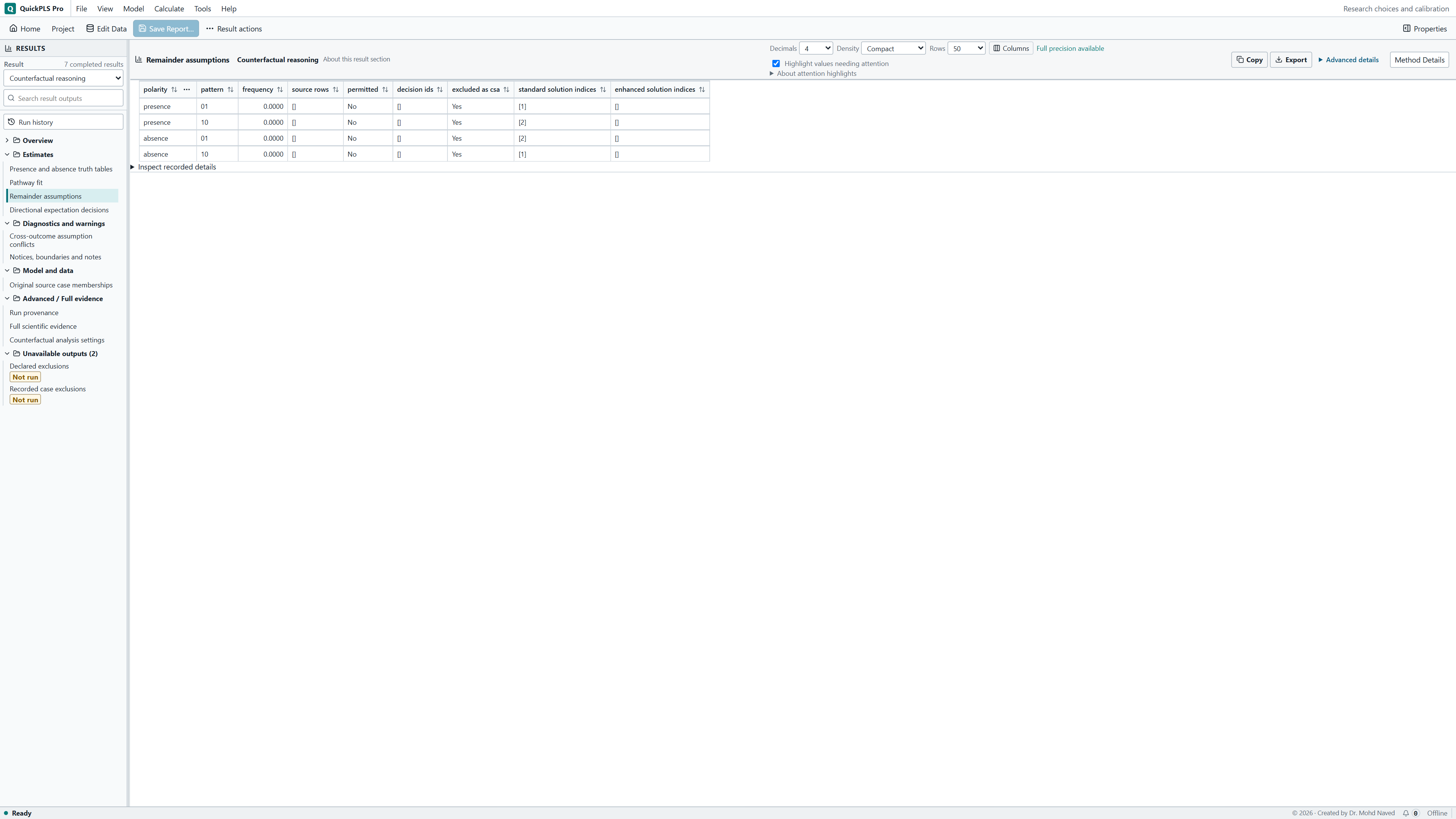
Choose Inspect both truth tables. Confirm that 00 and 11 are observed while 01 and 10 are remainders. Inspect which remainder each standard parsimonious alternative uses and whether the same gap receives conflicting assumptions across presence and absence. The preview inspects the setup; it is not the completed paired calculation.
What you should see: Both previews show the consequences of the selected assumptions.
How to read it: Inspect any restriction that changes available simplifications.
Save and calculate the selected procedure
Choose Save counterfactual revision, then Calculate both outcomes. When reading the result, select the exact family, pair and complete alternative rather than combining alternatives.
What you should see: The completed result records the selected procedure and its remainder assumptions.
How to read it: Keep these with the solution formula.
Try a clearly hypothetical restriction
In another teaching revision, suppose the study design makes 01 impossible. State that this is a hypothetical premise, enter the reason and inspect the changed solutions. The original two-case file does not prove that impossibility.
What you should see: The hypothetical restriction is saved separately.
How to read it: Describe it as a sensitivity exercise rather than observed evidence.
See which missing combination permits each simplification
For presence, 11 is the observed positive configuration. Combining 11 with unobserved 01 permits B; combining it with unobserved 10 permits A. These are alternative complete expressions. Reporting A OR B would create their union, a broader expression than either returned minimal alternative.
For absence, observed 00 together with unobserved 10 permits ~B, while 00 together with 01 permits ~A. The two outcome analyses can therefore make competing assumptions about the same gaps. In the supplied paired result, the selected conflict procedure removes the union of identified contradictory assumptions once. Its enhanced parsimonious expressions return to 11 for presence and 00 for absence. These are existing saved outputs, not a new comparison calculated for this page.
A missing outcome does not make the conditions unobserved
Open counterfactual-conflict.csv. It adds f03 with A = 0, B = 1 and missing Y. Even if the outcome calculation excludes that case, configuration 01 has occurred. Declaring 01 impossible conflicts with the observed conditions. The missing Y does not remove everything known about f03.
Check whether the impossibility claim is wrong or whether there is a genuine, documented data-entry error. Keep the observation and the reason for any correction visible. Removing f03 only to make the assumption acceptable would hide the evidence that challenges it.
Explain what the selected conflict procedure did
The enhanced procedure removes the identified union of conflicting assumptions once. It is not an open-ended process that keeps revising assumptions until no conflict remains. Inspect the remaining-conflict information and report the procedure, family and pair you actually used.
Both conservative expressions perfectly fit their one observed outcome case. That gives little basis for choosing a broader counterfactual explanation. For a real study, explain the knowledge that supports your treatment of 01 and 10. A design rule may justify impossibility, but an empty sample row alone does not.
Investigate the observation or assumption that conflicts
When a declaration is rejected or an expression becomes longer, inspect the exact combination and the reason attached to it. These checks help you resolve the research disagreement instead of changing the data just to obtain a simpler solution.
On a small screen, swipe the table sideways to see every column.
| Symptom | What to check | Action |
|---|---|---|
| An impossible configuration is rejected | Original condition values, including cases with missing outcomes | Reconsider the declaration or substantiate a real data correction. |
| A joint expectation cannot be saved | Whether the declaration uses different known conditions, includes opposite versions of a condition, or contains several clauses | Use the supported single conjunction, which combines conditions in a joint expectation, and explain your reason. |
| An enhanced expression is longer | Which remainders were removed or excluded | Explain the change in assumptions rather than calling the result inferior. |
| Presence and absence conflict | The remainder used by each selected alternative | Inspect presence and absence and report which enhanced procedure you used. |
| The report joins A and B | Whether they came from separate complete alternatives | Report the returned alternatives separately rather than inventing their union. |
Show what was observed and what was assumed
Report the observed configurations separately from the remainders used for simplification. Identify the actual outcome direction, family, pair and complete alternative, together with its assumptions and any remaining conflicts. The example below describes the teaching study only.
In the research review report builder select the actual paired counterfactual result and the saved study-note revision that explains its assumptions. Check the family, pair and complete alternative before preparing the report; the two-case example must remain distinct from any other saved example.
On a small screen, swipe the table sideways to see every column.
| Choice | Presence | Absence |
|---|---|---|
| Observed conservative expression | A* | ~A* |
| Standard parsimonious alternatives | B or A | ~B or ~A |
| Saved enhanced parsimonious expression | 11 | 00 |
| Reasons for assumption choices | Evidence and theory from the study setting | Evidence and theory from the study setting |
Example Methods paragraph
We used two synthetic cases to inspect counterfactual reasoning for outcome presence and absence. Configurations 00 and 11 were observed, while 01 and 10 were unobserved. We recorded directional expectations and inspected the remainders used by each alternative before interpreting the paired results.
Explain the change without overstating the evidence
You could write: The observed teaching cases supported A*B for presence and ~A*~B for absence. Standard parsimonious alternatives used unobserved configurations 01 and 10. In the saved paired example, removing the union of identified contradictory assumptions returned the enhanced parsimonious expressions to the observed combinations. This shows how assumptions affect the result; it is not an empirical conclusion about delivery.
Draw all four configurations and label those actually observed. Mark a hypothetical impossibility claim separately. Then add f03 from the conflict file and explain why its missing outcome does not erase the known combination. A reader needs that reasoning before judging the simplified expression.
- Identify the remainder used by each complete alternative.
- Label a teaching assumption as hypothetical.
- Inspect both outcome directions and any conflicts left after the procedure.
- Record the selected family, pair and alternative.
- Keep the original observations with the explanation of a conflicting assumption.
Use the supported expectation form
A known condition combination remains observed when its outcome is missing. Do not declare it impossible for that reason. The joint-expectation route accepts one conjunction per outcome direction; it does not accept arbitrary mixtures of atomic expectations and several joint clauses.