 QuickPLS
If your questionnaire separates Quality, Trust, Satisfaction and Loyalty, the first question is whether their proposed measurement pattern makes sense. Confirmatory factor analysis (CFA) specifies which items measure which factors and examines how well the model reproduces their observed relationships. It does not need a theory about which factor causes another. This is why a measurement-only fit is worth keeping before adding structural arrows.
Specify a covariance-only workshop model
Use the 360-case research workshop file. Import raw numeric data and use quality_1–3 for Quality, trust_1–3 for Trust, satisfaction_1–3 for Satisfaction and loyalty_1–3 for Loyalty. Keep identifier, group, weight and derived mean columns outside the blocks.
- On each factor, choose Properties → Inspector mode: Expert → Parameter. Set Measurement model to Reflective, and Scientific representation to Common factor. Set the first item in each block as its Marker indicator. The marker loading is fixed to 1 to define the factor scale. This does not mean that the marker item measures the factor without error.
- Connect all six pairs of factors. For each connection, choose Relationship type: Covariance, set Relationship use to Model covariance, then apply the relationship use. A line displayed for presentation alone is not an estimated covariance. Do not leave directed paths between these factors or add cross-loadings and residual covariances in the baseline.
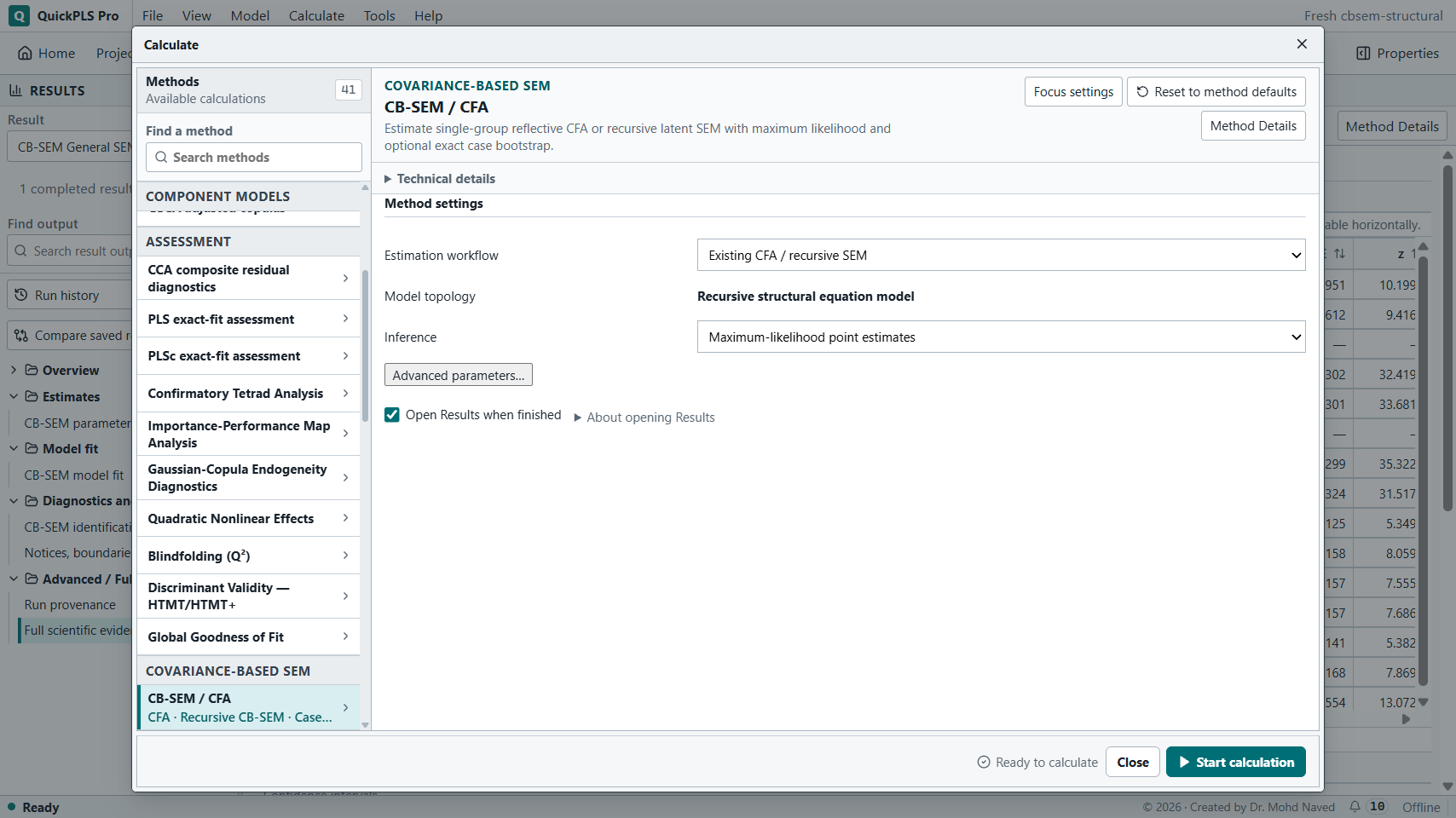
- Save this measurement model separately. Choose Calculate… → CB-SEM / CFA, Existing CFA / recursive SEM and Maximum-likelihood point estimates. Check that Model topology reads Confirmatory factor analysis. This starting workflow fits covariances without a separate moment-structure choice. Review readiness and calculate. QuickPLS CFA workflow
Read the solution in the right order
Begin with the analysed cases, convergence and admissibility. A negative residual variance or inadmissible factor covariance needs investigation even if the software returned a completed result. Then find Model parameters, Standardized parameters, Model fit and Residual covariance using Search result outputs. Names can be prefixed with CB-SEM. The lavaan CFA tutorial shows the same underlying distinction between factor indicators and covariance-model parameters, although its syntax is different.
Check the scale before comparing loadings. An unstandardised marker of 1 sets the factor’s units. A fully standardised loading of 0.70 on a different item means that, in a simple single-factor measurement equation, about 0.49 of that item’s variance is represented by the factor. It does not tell you that the fixed marker explains its item perfectly. The figures here are illustrative, not a checked workshop result.
Read the global fit and the local residuals together. For example, suppose a Trust item and a Quality item have an observed covariance of 0.36 and the model implies 0.21. That leaves an observed-minus-implied residual of 0.15 in their covariance units. Look up both items: do they use similar language, share a question stem or ask about the same event? One residual is a reason to investigate, not a licence to add a cross-loading or correlated errors. The example's values are hypothetical.
Decide what to retain before adding arrows
Record the proposed indicator map, free factor covariances, scaling choices, estimator, usable cases, fit summary and any important residual problem. If you test a model revision after inspecting the data, save it separately and describe it as such. Adding a structural path does not by itself cure a poor measurement model.
If convergence fails, check duplicate columns, empty or nearly constant items and incorrect covariance-line settings before modifying the theory. Keep any corrected input file separate from the file used in the failed model.
A report might say: “We first fitted a four-factor covariance-only CFA with first-item marker scaling and freely estimated factor covariances. We inspected model fit, residual covariances and admissibility before fitting the structural model.” Follow that sentence with the actual diagnostics, including any that contradict the planned measurement interpretation.