 QuickPLS
What the method does
The heterotrait-monotrait ratio (HTMT) compares correlations between indicators of different constructs with correlations within each construct. A high ratio raises concern that the two constructs are not empirically distinct. HTMT+ uses an absolute-correlation convention; the convention, theoretical distinction and uncertainty all matter when interpreting a pair.
HTMT ≈ mean between-block correlations / √(mean within-block correlations for A × mean within-block correlations for B).
The means exclude self-correlations. This expression describes the ratio; use the reported sign or absolute-correlation convention for the selected variant. A prespecified threshold and an interval answer related but different assessment questions.
Data and analysis in QuickPLS
Use eligible reflective indicator blocks and inspect item coding, within-block correlations and missing values. Single-item blocks cannot supply the same within-block information.
QuickPLS reports eligible construct pairs and the chosen HTMT assessment. Inspect the named pair and its indicators before deciding whether to revise a measurement model.
Follow a worked example
The following example shows the data, settings and decisions for one analysis. Use the linked practice files to follow it. For your own study, keep the procedure and choose the variables, model and settings that fit your research question.
Download research-workshop.csv to begin. It contains 360 rows and 31 columns. The example below identifies the variables to use, their roles and any rows to exclude; not every column is an analysis variable.
Do different construct names describe different measurements?
Discriminant validity concerns whether constructs meant to represent different concepts can also be distinguished in the data. The heterotrait-monotrait ratio, or HTMT, compares correlations between indicators of different constructs with correlations within their own reflective blocks.
QuickPLS reports original signed HTMT and HTMT+. The latter uses absolute correlations, so the two definitions can give different results when correlations have opposing signs. Read the labelled pair table alongside the matrix and inspect reasons for unavailable pairs. A numerical threshold helps assess the evidence; it does not replace a clear conceptual distinction between constructs.
Check item coding and decide the criterion
Check indicator direction, including any reverse coding, and confirm which blocks are reflective. Decide how you will interpret the labelled HTMT definitions and justify the criterion before looking at the ratios or intervals. The output contains both definitions; it is not a setting that switches one into the other.
Read the pair estimates, then request inference if needed
Open the intended measurement model
Open Calculate and choose Discriminant Validity — HTMT/HTMT+. Check the indicator assignments and reflective roles.
Choose the Inference route
Choose Point matrices, Fixed bootstrap inference or Configured bootstrap inference. If using the configured route, record the confidence, interval method, test type and criterion chosen for your question.
Inspect each labelled pair
Calculate and read the lower-triangle matrix with the full pair table. Keep original signed HTMT, HTMT+ and any bootstrap inference clearly distinguished. Investigate unavailable results rather than treating them as zero.
Read the estimate and uncertainty for the same pair
For each pair, identify the HTMT definition and check that the result is available. A point estimate below a criterion does not show how uncertain that estimate is. The bootstrap bound supplies additional evidence for the declared test. State whether your conclusion comes from the point ratio or the bound, and keep missing or inapplicable results separate from numerical zero. Each pair is assessed separately; its interval is not a simultaneous statement about every pair in the model.
On a small screen, swipe the table sideways to see every column.
| Output | How to read it | What to check |
|---|---|---|
| HTMT / HTMT+ | The pair-specific ratio under each labelled definition. | Use the same definition across software and reports. |
| Pair eligibility | The reflective construct pairs that meet the calculation requirements. | Do not fill unavailable pairs with zero. |
| Bootstrap interval / decision | Uncertainty for the chosen ratio and hypothesis. | An interval accounts for uncertainty that a point estimate alone does not show. |

When reliable blocks still overlap
Illustrative example, not a software benchmark
Two nearly synonymous constructs may have a problematic HTMT result even when both indicator blocks are internally reliable. Deleting indicators solely to lower the ratio could remove important content. Review construct definitions, wording and overlap before deciding whether a measurement revision is warranted.
Practice distinguishing the four reflective blocks
Use research-workshop.csv with the matching three indicators assigned to Quality, Trust, Satisfaction and Loyalty. Keep the starting structural paths. HTMT assesses the reflective measurement pairs, however: a significant path does not establish discriminant validity, and a low HTMT does not establish that path's causal direction.
The 360 synthetic cases contain invented continuous indicators, not validated questionnaire responses. Check coding and assignments and leave arithmetic-mean columns, case_id, group and weight outside the blocks. Before calculating, identify conceptually close pairs and explain the decision criterion. Do not relax the threshold only for a pair that misses the original rule.
Move from Point matrices to a declared bootstrap assessment
Confirm pair eligibility
Open Calculate and choose Discriminant Validity — HTMT/HTMT+. At least two reflective constructs need at least two indicators each. Only eligible reflective pairs are assessed in a mixed model; formative and single-indicator blocks do not receive substitute HTMT values.
What you should see: The intended pairs contain eligible reflective blocks.
How to read it: Resolve single-item or coding problems before calculating the ratio.
Start with Point matrices
Under Inference, choose Point matrices and click Start calculation. In the completed result, find HTMT+ and Original HTMT or HTMT — original signed correlations. Read the compact lower triangle and full pair table, distinguishing original signed HTMT from absolute-correlation HTMT+. Check why pairs are omitted or unavailable; a blank is not zero.
What you should see: Point matrices identify the construct pairs and ratio variant.
How to read it: Read the convention before comparing values with a threshold.
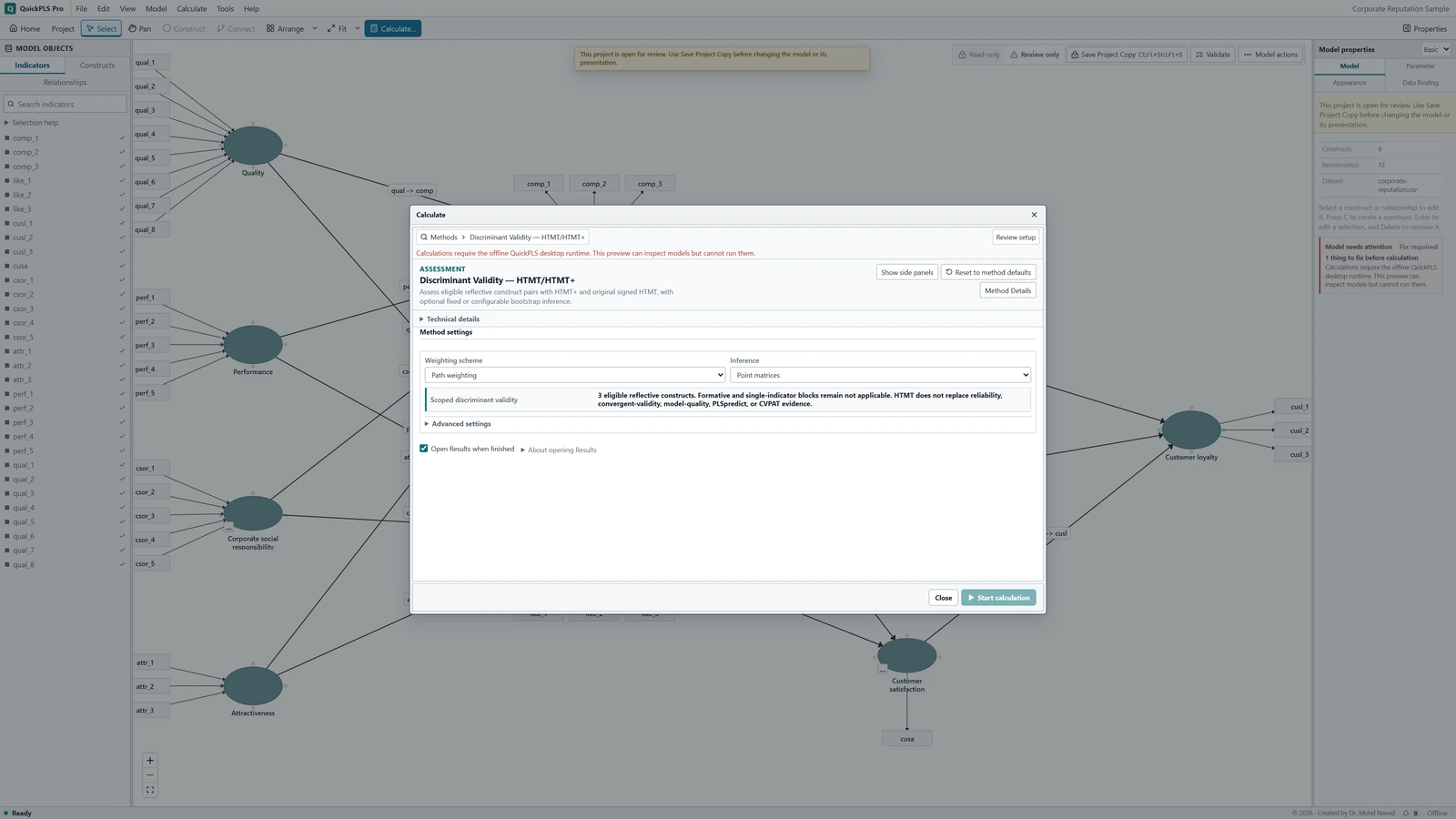
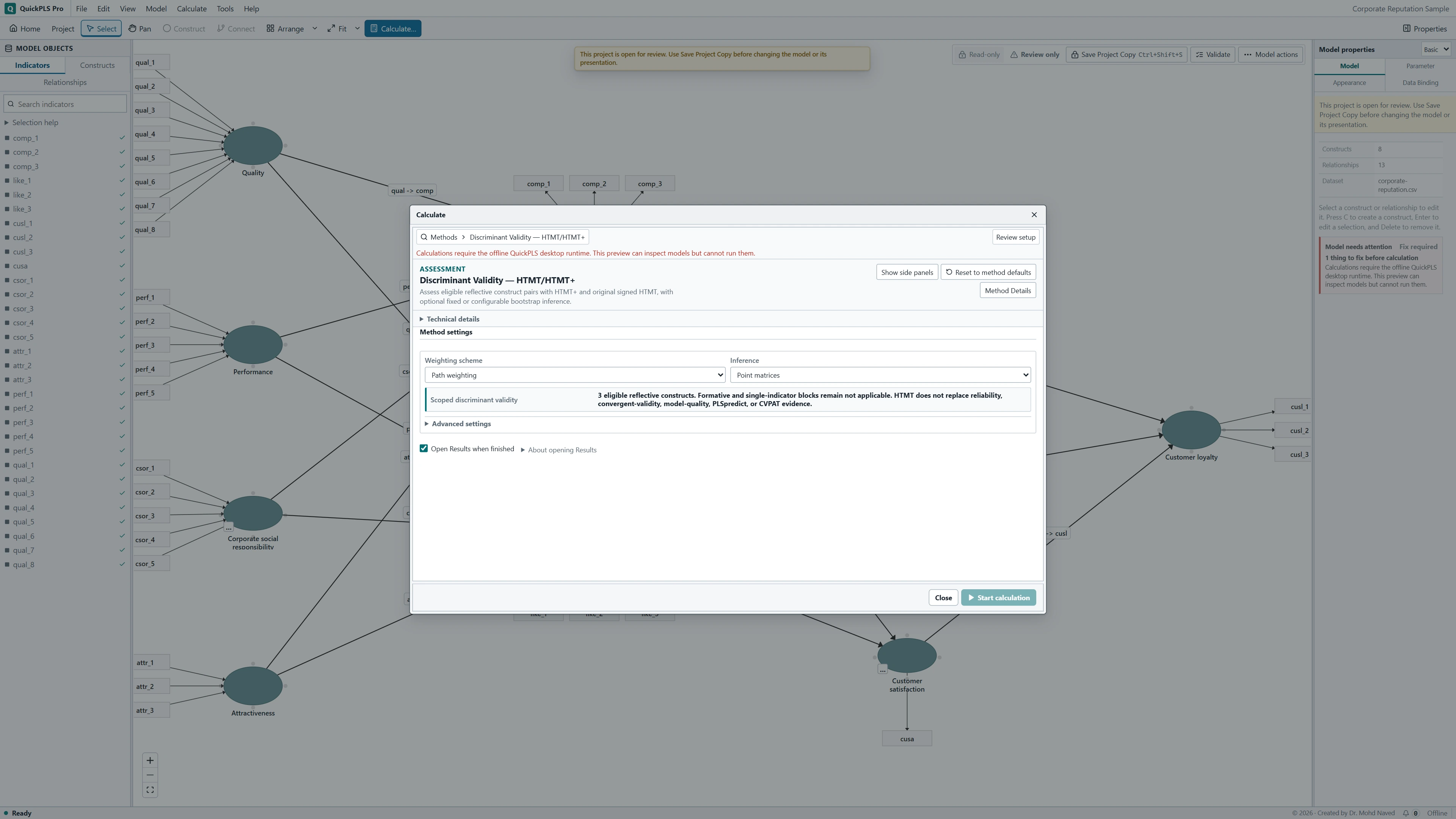
Discriminant Validity — HTMT/HTMT+ settings in QuickPLS. Select your own dataset and model, then use the choices described in the steps. Set the configured inference choices
Return to Calculate… → Discriminant Validity — HTMT/HTMT+ for the same model and choose Configured bootstrap inference. For this teaching exercise, set Confidence level (%) to 95, Confidence interval to Bias-corrected (BC, not BCa), Test type to One-tailed upper bound and Discriminant-validity criterion to 0.90. A real study must justify these choices.
What you should see: The inference settings state the planned test and interval.
How to read it: A point estimate alone does not contain uncertainty.
Record draws, seed and workers
Set Bootstrap draws to 1000 and Seed to 20261105, and record Workers. The interface accepts 999 to 10000 draws. These are Configured bootstrap inference settings. Fixed bootstrap inference is a separate option with its own predefined procedure. Review Readiness and click Start calculation to save the separate inference result.
What you should see: The requested draws, seed and workers are recorded.
How to read it: Check usable draws for each assessed pair.
Read each upper bound and its availability
Inspect the pair estimate, upper bound and usable draws. The upper bound must be strictly below the chosen criterion. A one-tailed 95% bound uses the upper endpoint of a 90% two-sided-equivalent interval. Choosing Two-sided interval changes the confidence statement.
What you should see: The upper bound and availability are shown for the named pair.
How to read it: Interpret it against the prespecified criterion and construct meanings.
Work through a point estimate and an upper-bound decision
Hypothetical arithmetic example: a mean cross-construct correlation of 0.60 divided by the square root of within-block means 0.80 times 0.80 gives HTMT 0.75. This shows the ratio's logic, not the result of analysing the CSV. Signed and absolute-correlation definitions can differ when correlations have opposing signs, so inspect coding before interpreting an unexpectedly small signed value.
In a hypothetical bootstrap result, HTMT+ is 0.88 and its one-tailed upper bound is 0.94. With a predeclared criterion of 0.90, the point estimate is below the criterion but the interval evidence does not support the requested conclusion. If the upper bound were 0.89, it would satisfy that particular rule. Equality at 0.90 does not meet a strictly-below requirement.
An HTMT+ value above one is not automatically a formatting error, and the calculation is not clamped to one. Read it as problematic evidence under the chosen measurement assumptions. Conversely, a low ratio alone does not establish reliability, convergent validity or meaningful item content. Those questions require their own assessment.
Availability is pair-specific. If one pair has 930 usable draws out of 1000 and another has 880, they need not have the same inference status under the 90% usable-draw rule. Keep their contributing samples and failure explanations distinct rather than applying the successful pair's status to the whole matrix.
Investigate the item or calculation problem behind the pair
On a small screen, swipe the table sideways to see every column.
| Symptom | Check | Reasonable action |
|---|---|---|
| A construct pair is absent | Check reflective roles and whether each block has at least two indicators. | Report the pair as not applicable or unavailable. Do not replace it with zero or infer validity from the omission. |
| Signed HTMT is small but HTMT+ is high | Inspect opposing item correlations and reverse-coded indicators. | Correct a documented coding error or explain the measurement structure. Do not choose the smaller definition simply to pass. |
| The point estimate passes but the upper bound does not | Check confidence, interval method and the criterion chosen before the analysis. | Report inconclusive interval evidence. More draws may stabilise the estimate but do not guarantee a different conclusion. |
| Bootstrap inference is unavailable for one pair | Inspect denominator failures and usable-draw counts for that pair. | Retain the missing reason. Do not borrow an interval from another pair or treat failed draws as zero ratios. |
| Deleting one indicator improves HTMT | Review the item's content and the effect on construct coverage. | Remove an item only with a defensible measurement rationale, preserve the original result and identify the revised analysis as such. |
Make revisions that preserve the intended concepts
Start with the constructs and item content. If two blocks measure nearly the same thing, revisit the theoretical reason for separating them. Merging them changes the research question; it is more than a numerical repair. Where the distinction matters but measurement is weak, better items or new data may be needed.
A planned comparison of BC and Percentile intervals can assess sensitivity to interval construction. Keep the criterion and test type fixed and report both. BC is not BCa. Do not keep changing confidence levels, thresholds or methods until a desired upper bound appears.
Example wording for the criterion and its uncertainty
Methods example: "Discriminant validity was examined for eligible reflective pairs using HTMT and HTMT+. We prespecified a criterion of 0.90 and assessed the one-tailed 95% upper bound with bias-corrected percentile intervals. The configured bootstrap used 1000 draws and seed 20261105; pair-specific usable counts and unavailable results were retained."
Hypothetical Results example: "For Quality and Trust, HTMT+ was 0.88 and its upper bound was 0.94. Although the point estimate was below 0.90, the interval did not support the prespecified criterion. We reviewed item overlap rather than declaring discriminant validity from the point estimate alone." Replace the invented pair values with the actual saved output.
| Field | Report |
|---|---|
| Measurement | Eligible constructs, indicator coding and the pairs included. |
| Definition | Signed HTMT or absolute-correlation HTMT+. |
| Decision | Criterion, confidence, test type and interval method. |
| Bootstrap | Draws, seed, workers and pair-specific failures. |
| Conclusion | Supported or inconclusive pair evidence and justified measurement revisions. |
Check the pair-level conclusion
- Explain how original HTMT differs from HTMT+.
- Repeat the illustrative ratio calculation.
- Distinguish a point comparison from an upper-bound decision.
- Explain why BC must not be labelled BCa.
- Keep discriminant validity separate from reliability, prediction and causal claims.
Report the definition, criterion and pair-level evidence
- Name the HTMT variant used for each conclusion and list the eligible pairs.
- State the criterion and inference procedure chosen before inspecting the results.
- Discuss problematic or unavailable pairs and explain any measurement revision.
A threshold does not settle the whole measurement question
Signed HTMT and HTMT+ use different definitions. Neither an omitted pair nor a low ratio establishes validity on its own. Report unavailable pairs as such and assess item meaning, reliability and other measurement questions separately.