 QuickPLS
What the method does
A tetrad is the difference between two products of covariances. Certain reflective factor models imply that particular tetrads are zero. Confirmatory tetrad analysis evaluates those restrictions with uncertainty. Rejection challenges the tested restrictions; non-rejection alone does not establish that a measurement block is reflective.
Tetrad: τ = σ₁₂σ₃₄ − σ₁₃σ₂₄.
σᵢⱼ is the covariance between indicators i and j. Under the relevant one-factor restrictions, the tetrad vanishes. Bootstrap intervals assess whether the observed tetrad is compatible with zero; multiple tested tetrads require the stated multiplicity treatment.
Data and analysis in QuickPLS
Use eligible indicator blocks with enough distinct indicators for the requested tetrads. Specify the measurement interpretation before selecting or testing restrictions.
QuickPLS calculates the requested tetrads and their resampling evidence. Read the indicator identities and interval for each restriction, then revisit the measurement theory if the restrictions are challenged.
Follow a worked example
The following example shows the data, settings and decisions for one analysis. Use the linked practice files to follow it. For your own study, keep the procedure and choose the variables, model and settings that fit your research question.
Download tetrad-workshop.csv to begin. It contains 360 rows and 8 columns. The example below identifies the variables to use, their roles and any rows to exclude; not every column is an analysis variable.
Test a specific measurement restriction
Some measurement models imply that certain differences between products of indicator covariances should be zero. Such a difference is a tetrad; one expected to be zero is often called a vanishing tetrad. Confirmatory tetrad analysis examines these restrictions for the selected indicator block.
Indicator order determines the anchored family, the restrictions tested together. Some tetrads are mathematically related, so counting each as an independent test would overstate the evidence. Record the order, selected family, covariance checks and multiple-testing adjustment. The result tests these restrictions, not the meaning of the construct.
Choose the indicator block and keep its order
Use a block that meets the indicator requirements. Write down its indicator order and which measurement assumptions imply the tested zero restrictions. Record the anchored family generated from that order before interpreting the estimates or intervals; do not rearrange indicators to obtain a more favourable result.
Choose descriptive tetrads or bootstrap assessment
Open the intended indicator block
Open Calculate and choose Confirmatory Tetrad Analysis. Check the Eligible indicator blocks list and their indicator order.
Choose the assessment
Under Assessment, choose Descriptive tetrads or Bootstrap tetrad assessment. For bootstrap inference, record the anchors, tested family, confidence settings and within-block adjustment.
Read estimates with their diagnostics
Calculate, then inspect the tetrad estimates and any intervals with the covariance and rank diagnostics for that same family. Do not interpret an interval independently of its prerequisite checks.
Check zero, the adjusted interval and the warnings
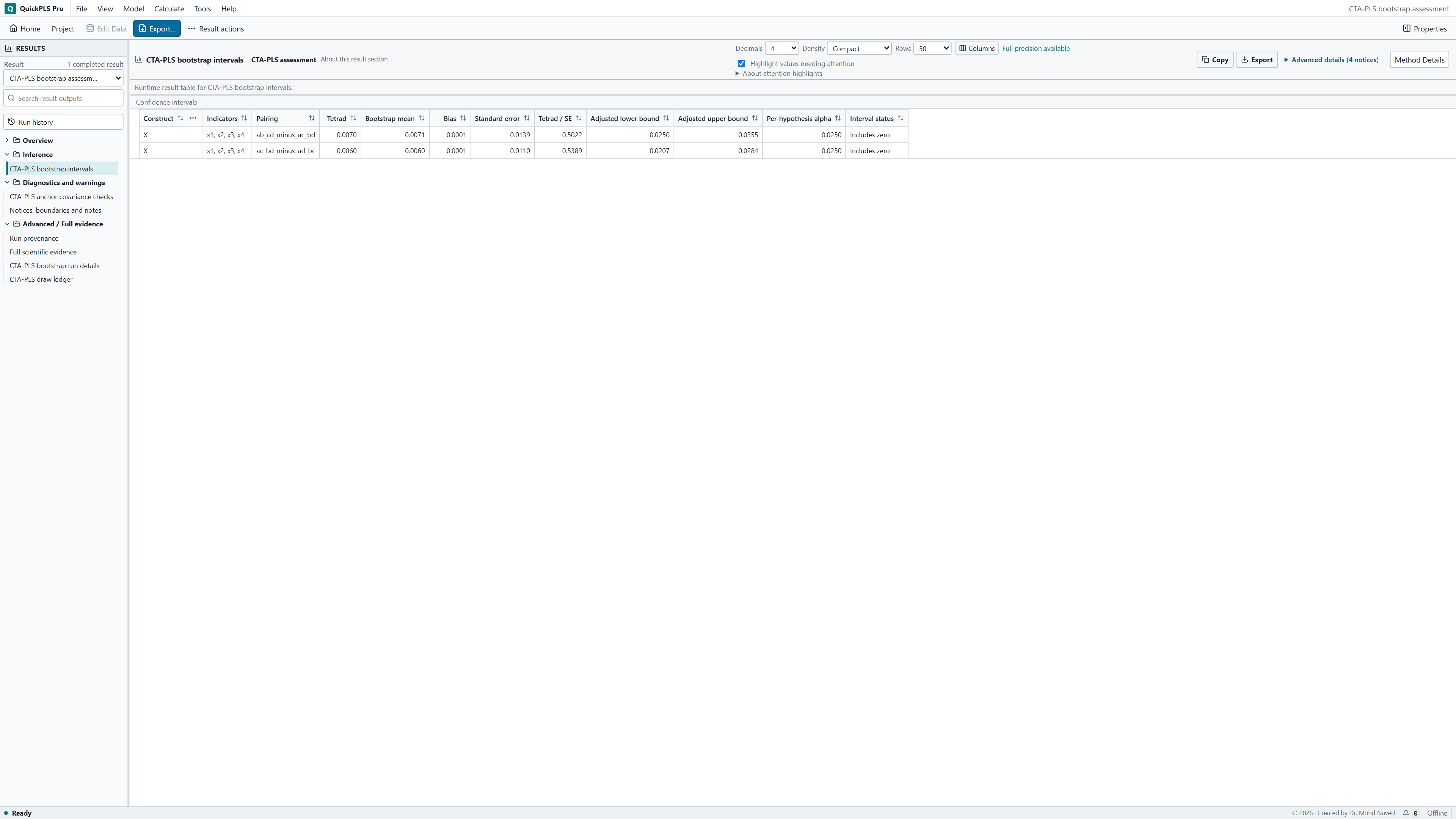
In the bootstrap result, use Search result outputs to find CTA-PLS block assessment, CTA-PLS bootstrap intervals and CTA-PLS anchor covariance checks. Check the block status and covariance/rank diagnostics before interpreting the adjusted intervals. A tetrad is a covariance-product difference; its sign depends on indicator order. Read whether zero is included under the stated family adjustment, and use CTA-PLS bootstrap run details and CTA-PLS draw ledger to check the plan and usable draws.
On a small screen, swipe the table sideways to see every column.
| Output | How to read it | What to check |
|---|---|---|
| Tetrad estimate | The covariance-product difference that the measurement model predicts should be zero. | The sign depends on the chosen ordering. |
| Bootstrap interval | Uncertainty around that tetrad under the configured procedure. | Check whether the interval includes zero after the stated adjustment for multiple testing. |
| Covariance / rank diagnostics | Checks that the selected restrictions provide the information needed for inference. | Investigate redundant restrictions or insufficient variation before interpreting intervals. |
What an interval excluding zero challenges
Illustrative example, not a software benchmark
An interval excluding zero challenges a particular vanishing-tetrad restriction. It does not prove that the construct must be formative. Review indicator content, the assumptions and the remaining restrictions before changing the measurement model.
Use the dedicated four-indicator practice block
Download tetrad-workshop.csv. Its 360 synthetic cases contain case_id, item_1 to item_4 for Concept, and target_1 to target_3 for an optional Target. Assign the four item columns to Concept in their original order. If the setup needs a structural relationship, create Target from its three matching indicators and draw Concept → Target. Keep case_id outside the model.
The ordinary research-workshop file has only three indicators per block, so it cannot provide a within-block tetrad. Do not borrow a Trust item and call it Quality to reach the minimum. The dedicated file supplies four indicators for one teaching construct. Its generated data do not validate a real construct or determine how your questionnaire should be specified.
Inspect the descriptive result before requesting intervals
Confirm the eligible block
Open Calculate and choose Confirmatory Tetrad Analysis. In Eligible indicator blocks, confirm that Concept has four indicators in the intended order. Connecting the three-indicator Target does not make that block eligible.
What you should see: The block contains the intended distinct indicators.
How to read it: A tetrad tests a specific covariance restriction among them.
Start with Descriptive tetrads
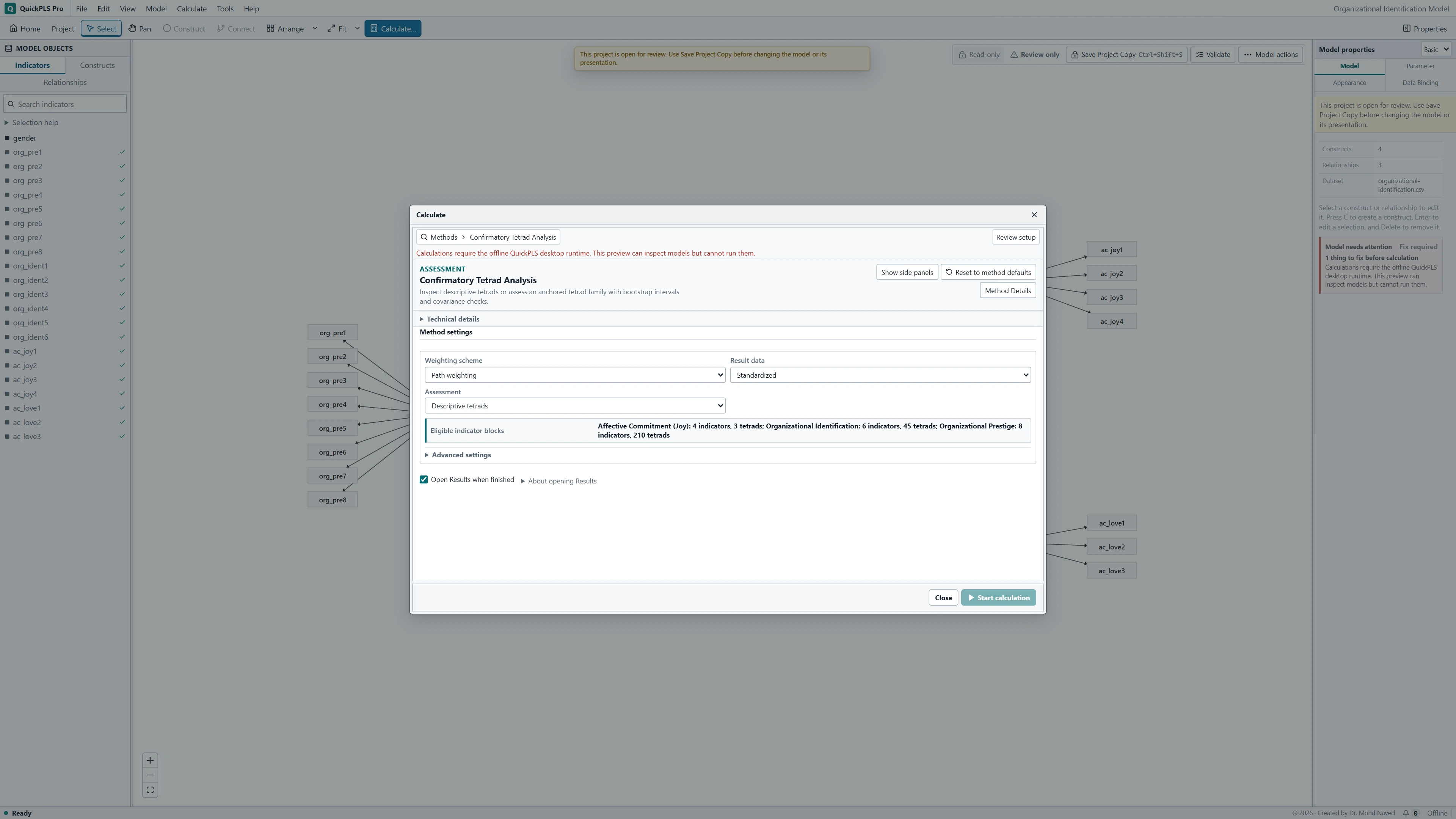
Under Assessment, choose Descriptive tetrads and click Start calculation. In Results, use Search result outputs to open CTA-PLS tetrad summary and CTA-PLS tetrads. Read the pairings and identify which covariance products are subtracted. Their order determines the sign. These values are descriptive; they do not give a significance decision or decide between reflective and formative measurement.
What you should see: The descriptive tetrad tables name the covariance pairings and signs.
How to read it: They do not provide a significance decision.

Confirmatory Tetrad Analysis settings in QuickPLS. Select your own dataset and model, then use the choices described in the steps. Enter a declared bootstrap plan
Return to Calculate… for the same model and choose Confirmatory Tetrad Analysis → Assessment → Bootstrap tetrad assessment. Set Bootstrap draws to 1000, Confidence level (%) to 95, Interval method to Bias-corrected percentile, Test direction to Two-sided and Seed to 20261105. You can request 500 to 10000 draws. Record the plan, check Readiness and click Start calculation. This teaching plan does not guarantee precise tail estimates.
What you should see: The requested uncertainty and multiplicity settings are recorded.
How to read it: These choices affect how the restrictions are assessed.
Keep the interval method and direction clear
Bias-corrected percentile means BC, not bias-corrected and accelerated BCa. Percentile is the other option. Keep the planned 95% confidence level for this exercise. Positive tetrads and Negative tetrads are directional alternatives; use them only for a hypothesis chosen before seeing the signs.
What you should see: The interval label distinguishes bias-corrected percentile from BCa, and the test direction is explicit.
How to read it: Keep those labels unchanged when reporting.
Read the tested family and anchor checks
Read the selected nonredundant family, the set that avoids repeating mathematically related restrictions. Read its Bonferroni-adjusted intervals and anchor-covariance diagnostics together. Bonferroni adjusts for testing several restrictions within the block; anchor checks remain two-sided. Inspect usable draws, weak covariances and rank warnings, which concern whether the restrictions supply distinct information, before interpreting an interval that excludes zero.
What you should see: The conclusion identifies the challenged restrictions.
How to read it: Non-rejection alone does not prove that the block is reflective.
Work through the covariance arithmetic and intervals
Hypothetical arithmetic example: let covariances s12 and s34 be 0.60 and 0.50, and s13 and s24 be 0.40 and 0.75. The tetrad s12 times s34 minus s13 times s24 is 0.30 minus 0.30, or zero. Changing s24 to 0.60 gives 0.30 minus 0.24, or 0.06. These values illustrate a covariance restriction; they are not measured covariances from the practice file.
A four-indicator block has three descriptive pairings, but they are algebraically related. The selected anchored family has two restrictions, not three independent confirmations. With more indicators, the distinction between all descriptive rows and the tested family becomes more important. Keep the original indicator order rather than choosing anchors because their results look convenient.
Suppose a hypothetical adjusted interval for one tetrad is 0.01 to 0.09. It excludes zero and challenges that tested vanishing restriction, provided the prerequisite diagnostics support interpretation. An interval from -0.03 to 0.08 does not reject it. Neither result proves formative causation or establishes the conceptual direction between a construct and its indicators.
Respond to weak or missing tetrad evidence
On a small screen, swipe the table sideways to see every column.
| Symptom | Check | Reasonable action |
|---|---|---|
| No eligible block appears | Count distinct assigned indicators within each construct. | Use the four-indicator practice block. Do not combine unrelated items just to reach the minimum. |
| Anchor covariances are weak or inconclusive | Read the anchor intervals and their two-sided adjustment. | Report the limitation. Do not reorder indicators after seeing the results to find stronger anchors. |
| An interval is unavailable | Inspect usable-draw counts, zero bootstrap variance and rank diagnostics. | Preserve the unavailable result and investigate the data or model problem. It is not an interval centred on zero. |
| A pointwise interval excludes zero but the adjusted interval does not | Check the tested family size and Bonferroni adjustment. | Use the family-level procedure you specified. Do not switch to the more favourable pointwise conclusion. |
| A tetrad is rejected | Review item content, possible correlated errors and the assumed measurement structure. | Treat this as evidence against the tested restriction. Any formative reinterpretation needs substantive justification beyond the test. |
Revise the measurement question for a stated reason
Investigate a data-entry or reverse-coding error when there is separate evidence for it. Preserve the original analysis and document the correction. If theory supports a different set of items, treat it as a new specification rather than deleting the item linked to an inconvenient tetrad.
A planned comparison of Percentile and Bias-corrected percentile intervals can show sensitivity to interval construction. Keep the indicator order, draws and hypothesis family unchanged. More draws may improve tail resolution, but they cannot fix nearly unrelated indicators or establish measurement assumptions. Report nonsignificance as insufficient evidence against the tested restriction.
Example wording and details needed for the tested family
Methods example: "We assessed the Concept block with indicators item_1 to item_4 in the stated order. Descriptive tetrads were inspected before the anchored bootstrap family. We used 1000 draws, 95% bias-corrected percentile intervals, two-sided tests and seed 20261105, with the within-block Bonferroni adjustment and anchor diagnostics."
Hypothetical Results example: "One adjusted tetrad interval was 0.01 to 0.09 and excluded zero. We interpreted this as a challenge to the specified vanishing restriction, not automatic evidence for formative measurement. The remaining restrictions and prerequisite covariance diagnostics were reported alongside it." Use your saved values and include failures.
| Item | Report |
|---|---|
| Block and order | Indicator names, descriptive pairings and selected family. |
| Inference | BC or Percentile, confidence, direction, draws and seed. |
| Dependence | Family adjustment, anchor-covariance and rank diagnostics. |
| Results | Tetrad estimates, adjusted intervals, usable counts and unavailable rows. |
| Interpretation | Conclusion about the tested restriction and a separate measurement rationale for any revision. |
Check your interpretation
- Explain why a three-indicator block cannot form this tetrad.
- Repeat the illustrative covariance-product subtraction.
- Distinguish three descriptive pairings from two selected restrictions.
- Name BC correctly and explain how it differs from BCa.
- Write a rejection or non-rejection conclusion without automatically changing measurement type.
Name the exact restrictions tested
- List the indicator order and the anchored tetrad family.
- State whether the results are descriptive or inferential, with interval, direction and multiple-testing choices.
- Report covariance and rank warnings, then explain the measurement conclusion they permit.
A tetrad does not choose the measurement theory for you
A rejected tetrad challenges its tested zero restriction. A nonsignificant result does not establish the measurement theory. Because some tetrads depend on others, they must not be counted as independent confirmations or discoveries.